Website Builders vs Custom Websites: Wix, Canva or a Dedicated Site?
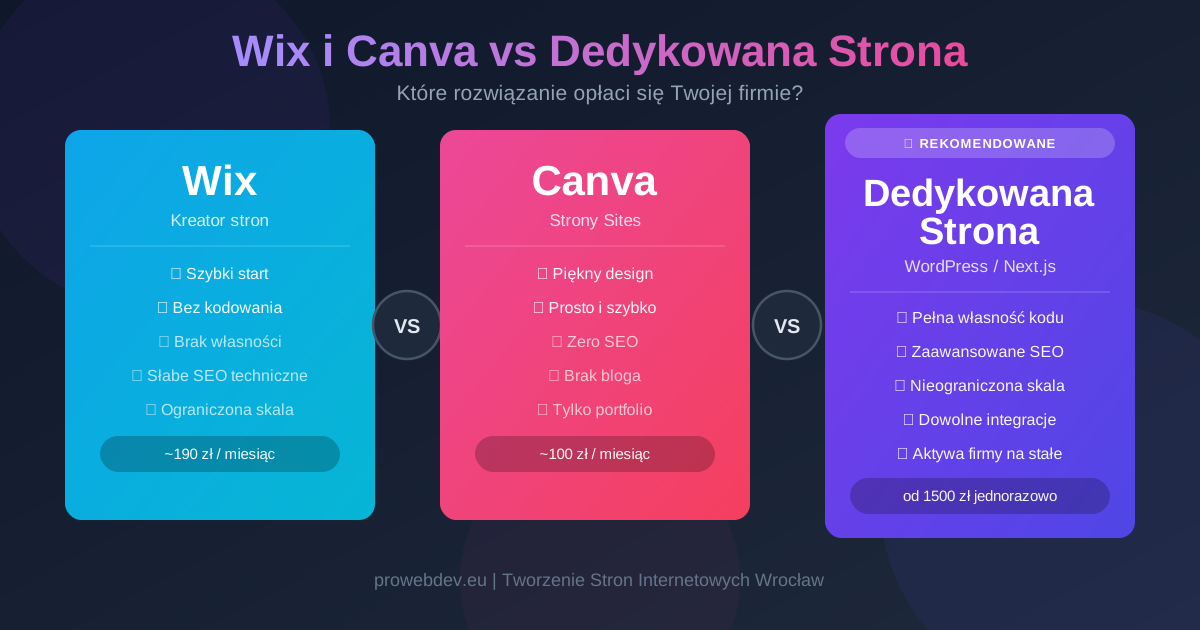
Does Wix cut it, or do you need something custom?
It's one of the questions I get regularly. And the honest answer always starts with another question: what do you actually need this website to do?
Builders really have lowered the barrier to entry. You can have a site up this weekend, no technical skills needed, for around $20 a month. That's genuinely true — and for a certain type of business, it's a reasonable choice.
The thing is, that group is narrower than Wix's ads suggest. Let's look at where the line actually is.
Website builders: Wix and Canva
Speed to launch
Builders have one thing nothing else can beat: how fast you can go live. Wix has over 900 templates — pick one, swap in your logo and copy, hit publish. Canva Sites is even simpler, you design it like a slide deck and export it as a webpage.
For someone who needs an online presence fast and doesn't want to spend a few thousand upfront, that's a real advantage. A beauty salon, a photographer, a consultant just starting out.
But that simplicity has consequences that tend to show up a year or two down the road.
What it actually costs
Wix Business runs about $17–29 a month right now. That's roughly $200–350 a year. Over three years you'll pay $600–1,050 and still own nothing. Stop paying and the site disappears.
Canva Sites is cheaper, but the website features are pretty bare-bones. It works as a kind of portfolio or social media supplement, not as a serious business website.
On top of the base price, you'll typically pay extra for your own domain, removing Wix branding, better templates, and any e-commerce add-ons. It's easy to end up 30–50% above the advertised price.
Limitations that surface over time
You have no server access. That sounds technical, but it means one practical thing: you can't install anything outside what the platform offers, and you can't move the site to a different host. You're stuck on Wix.
Wix tends to generate fairly heavy code and pages load slower than custom-built ones. That shows up in PageSpeed scores, and Google does factor loading speed into rankings.
The biggest catch comes if you ever want to switch platforms. If you decide after two years that you need WordPress or something custom, you can't export your content in one click. You start over.
SEO on Wix and Canva
Wix has actually fixed a lot of its SEO over the past few years, credit where it's due. You get a meta tag editor, an auto-generated XML sitemap, and clean URLs. For a local business with modest organic ambitions, that can genuinely be enough.
But serious technical SEO on Wix is mostly off the table. Core Web Vitals optimization hits a wall, schema.org structured data is very limited, and you have no control over rendering or caching. You're not going to rank for competitive terms.
Canva Sites is a different story from an SEO perspective — and not a good one. Subpages don't get indexed, there's no blog, nothing is configurable. It's a portfolio tool, not a lead generation tool.
Custom website: what you get instead
Ownership and independence
A custom site on WordPress or Next.js is yours — the code, the data, the content. You host it wherever you want, you can sell it, move it, or switch providers if yours gets expensive.
Not being tied to one vendor is something that's hard to appreciate until you're trapped. When Wix raises prices or drops a feature you rely on, you have no leverage. On your own site, you just change hosts.
For a business that earns money online, that independence is foundational.
Ongoing costs
Running a custom WordPress site costs roughly $12–35 a month for hosting and $10–20 a year for the domain. Technical maintenance — updates, backups, security monitoring — runs from about $50 a month.
With a one-time build cost of $400–2,000 and ongoing costs around $60–85 a month, the three-year total usually comes out similar to Wix or less. Except you own the site outright instead of renting it.
More importantly, a business website that drives traffic and leads is a company asset. Something with real value that you can sell along with the business.
SEO without platform limits
On a custom site you have full control over technical SEO. You can tune Core Web Vitals for your specific setup, add complete schema.org structured data, and configure your sitemap exactly how you need it.
WordPress with solid plugins like Yoast or RankMath gives you a strong SEO foundation and genuinely moves the needle. Next.js goes further — static pages load fast and PageSpeed scores are excellent.
If you want customers to find you through Google, a custom site isn't a luxury.
When it makes sense
A custom site is worth the investment when:
- ✓the site needs to generate enquiries and sales, not just exist
- ✓you're planning a blog or content marketing
- ✓you need integrations with other software
- ✓the business is growing and the site needs to keep up
- ✓you want full control over your data and code
- ✓Google rankings actually matter to you
If the site needs to earn, not just sit there, builders won't cut it.
Cost comparison over time
Small business, 3-year view
| Factor | Wix Business | Custom (WordPress) |
|---|---|---|
| Upfront cost | $0 | $400–$2,000 |
| Monthly cost | $23/month | $12–50/month (hosting + care) |
| Total over 3 years | $828 | $800–$3,800 |
| You own the site | NO | YES |
| Can migrate | Practically no | Yes, anytime |
| Technical SEO | Basic | Full |
With maintenance from $50/month, a custom WordPress site becomes cost-comparable to Wix around the 2.5-year mark — with full ownership and better SEO.
Where Wix starts getting in the way
As you grow, requirements pile up. You need an English version, a booking system integration, a shop, a client portal. Wix has some of those, but each one means a higher plan, more constraints, and less flexibility.
Businesses that outgrow Wix end up migrating to WordPress or Next.js — which costs as much as building from scratch. If they'd started with a custom site, that cost wouldn't exist.
Which is right for you
Wix and Canva make sense for freelancers, artists, and small service providers who need an online presence quickly without a big upfront investment. That's a legitimate use case.
For a business that wants to earn through its website, going custom is an investment, not an expense. After two or three years it's cheaper than Wix, you have more options, and you actually own what you've built.
Before you decide, ask yourself one question: should this site be an online brochure, or a tool that brings in work? That answer tells you everything.
Need a site that actually works?
I build custom WordPress and Next.js websites for businesses that take the web seriously. Free consultation, quote within 48 hours.